
By Hannah Stephenson
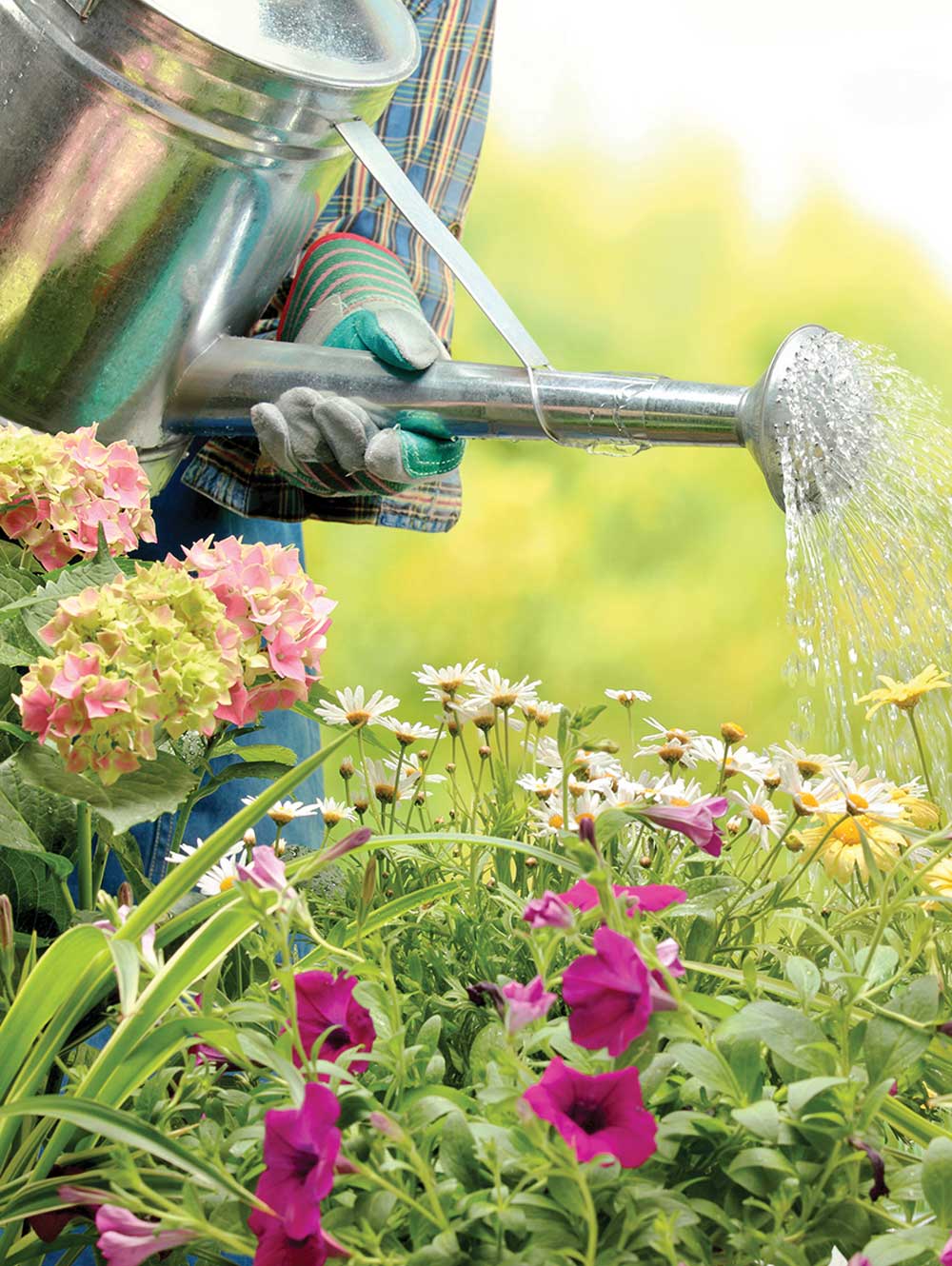
As container plants begin to flourish and hanging baskets start to look their best, it’s the watering that’s the hassle. It’s the most time-consuming chore of summer, especially if you have loads of pots.
Many of us use drought-tolerant plants such as geraniums, agapanthus, alliums, euphorbias and hebes to ease the burden of watering, and most established shrubs and perennials need less watering because their roots go deep enough to find moisture.
If you don’t want to be limited in the plants you choose, you can install automatic irrigation systems. Choose a system which has a supply pipe that carries the water around the garden, and micro-tubing that can be fitted with individual nozzles which drip water at an even rate. Starter kits are available for self-assembly, and you can add extra pipes and nozzles later to extend the system. Connect the system to an outside tap and turn it on and off by hand, or add a timing device to do it automatically.
The busy gardener should focus only on plants that need watering: those in containers; and newly-planted specimens in borders, which will need to be kept moist until they are established.
Don’t get the hosepipe out to your borders in full sun on a hot day as lightly spraying the surface does no good at all, and in any case very few areas of the garden need watering daily. Instead, in hot weather water in early morning or evening to reduce evaporation, and try to keep it around the base of the stem.
Aim water at the roots of trees by inserting a section of drainpipe filled with gravel next to the tree and pouring water down that – it should go directly where it’s needed.
Make a ridge of soil around shrubs which will hold the water in place as it soaks in. For plants in rows or smaller plants, install a seep hose. Alternatively, sink a plastic flower pot into the ground next to a plant which is likely to need watering and fill it up, which directs the water under the surface to the rooting zone of the plant.
On the patio, you can buy equipment which will save time on watering by hand. Line porous containers with polythene before planting, but don’t cover the drainage holes. There are also self-watering containers with a reservoir built into the base and a wick connecting the reservoir to the compost.
Stand summer pots on pot saucers so at least some of the water which has drained out will remain at the base and hopefully still seep up into the soil.
A few easy changes to your watering habits should mean you can still enjoy your garden without having the hose out all the time.