
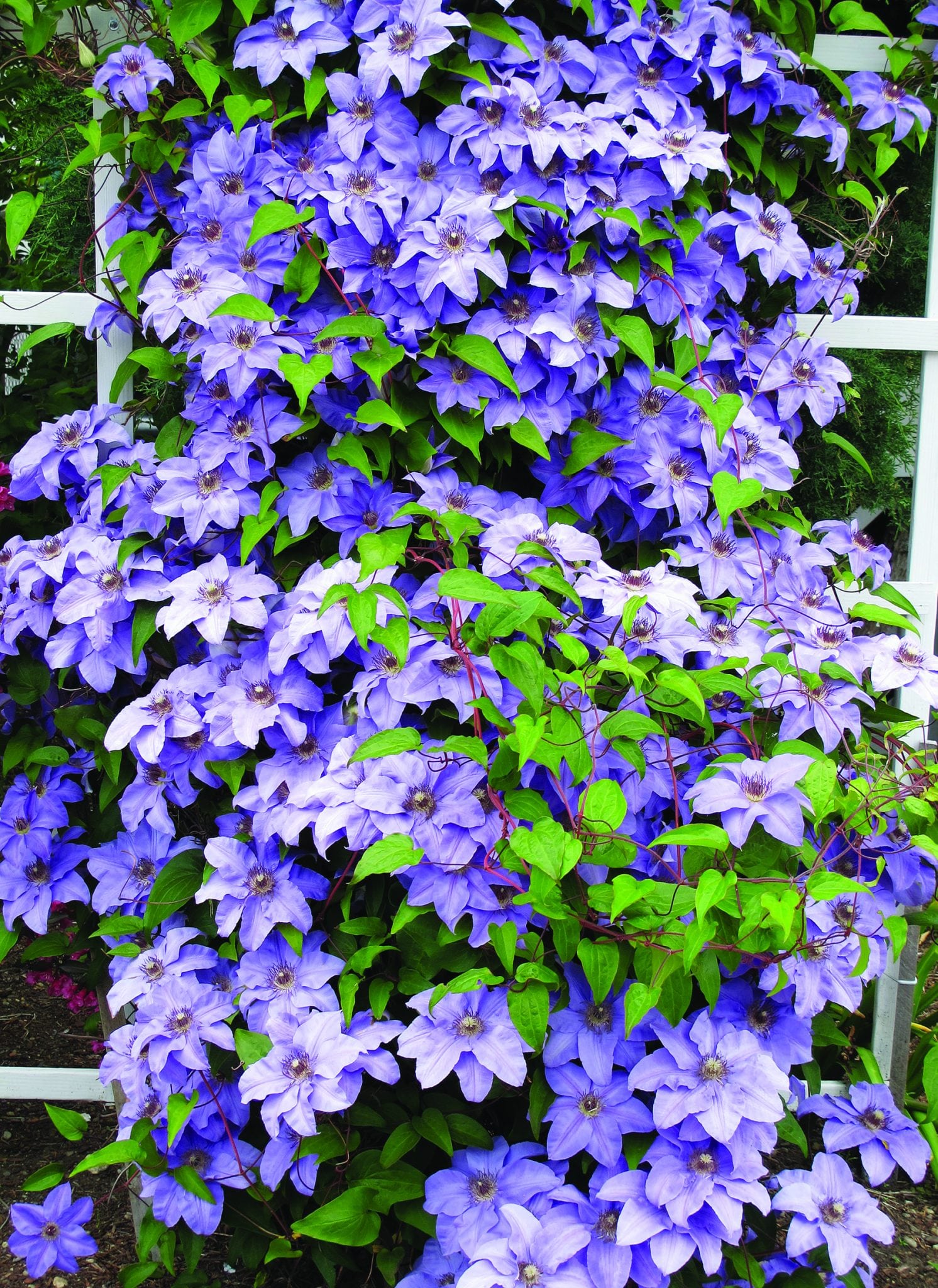
CUT THE CONFUSION OVER CLEMATIS
By Hannah Stephenson
I love the huge flowers of hybrid clematis as they climb up trellis and fencing, or weave their way through
less interesting shrubs, wrap themselves around tree trunks and scramble over old walls to create a burst of
colour, often in shadier places.
They make perfect companions entwined with deliciously scented climbing roses covering arches and pagodas in
the romantic garden, or simply climbing up unsightly walls or fences to act as a colourful screen.
In fact, different types of clematis can provide you with flowers for most of the year.
Yet, clematis are the climbers which cause the most confusion when it comes to pruning because there are three
groups of them, and if you prune the wrong type at the wrong time you’ll ruin your chances for blooms this
year.
Group 1 clematis, which flower in spring, bloom on stems which grew the previous year and are generally pruned
after flowering. They are often rampant growers with large numbers of relatively small flowers – C.
macropetala and C. montana are well-known examples, although C. alpina, cirrhosa and amandii also fall into
this group. Prune them straight after flowering by clipping the sideshoots back to a few buds of the main
framework.
They should not be pruned in the winter, or you’ll cut off all the shoots and lose the new season’s flowers.
Now is the time to prune summer-flowering clematis, the Group 2 types, which bloom on stems produced in the
current season. They are pruned in late winter or early spring to remove much of last year’s growth. If left
unchecked they will produce flowers, but they will tend to be at the end of the plant where you probably won’t
be able to see them.
Group 2 clematis include many of the large-flowered hybrids, including the most famous pink striped variety
‘Nelly Moser’, the rich purple ‘The President’ and other popular types including ‘Marie Boisselot’ and
‘Lasurstern’.
The aim with pruning Group 2 clematis is to retain a framework of old wood, and also to stimulate new shoots
to maximise flowering throughout the season.
Unless the plant already has three or four healthy stems growing from the base, all newly planted clematis
should be pruned back hard the first spring after planting. Cut back to just above a strong pair of leaf buds
about 30cm above soil level. This will encourage multiple stems which can be trained into supports to give a
good coverage.
With established plants, remove dead or weak stems before growth begins, check individual stems from the top
down until you reach a pair of healthy buds, and prune just above them, removing the spindly or damaged growth
above. The ones that flower first in early summer, and again in late summer, need a tidy-up rather than a
heavy prune.
Those which must be pruned now are those which don’t start flowering until June, and keep going until the
autumn, as they make vigorous growth and only flower on the very ends of the shoots.
They can be cut back to a pair of fresh green buds about 30cm in early spring, and then new growth tied into
the supports.
Some mid to late summer flowering clematis can be treated as either Group 2 or Group 3, as desired, including
‘Comtesse de Bouchaud’, ‘Gipsy Queen’ and ‘Hagley Hybrid’.
Group 3 are late summer and autumn-flowering clematis including viticella and texensis and some large-flowered
types including ‘Niobe’, ‘Perle d’Azure’ and ‘Ernest Markham’. They flower on both last year’s and the current
season’s growth.
In the first year, prune them back in late winter or early spring to the lowest pair of healthy-looking buds
you can find, which will be about 30-90cm above the ground. This may mean cutting off green, healthy shoots,
but the plant will reshoot from the base and be better for it.
Best of the bunch – Iris reticulata
This dainty little rockery iris may not last for long, but its rich 10cm
flowers in shades of blue or maroon are a welcome respite from an often
colourless scene at this time of year. The flowers appear weeks ahead of
the grassy leaves, and bulbs should be planted in autumn in a sunny,
well-drained spot, ideally a rockery or scree bed. Or, if you have some
spare pots, plant a handful in them, adding grit to the soil, and leave
them on pot feet so the bulbs won’t rot from the damp ground. In
February, you can move them to a spot on the patio where you can see
them. Avoid planting them in busy beds and borders where they can easily
get lost. Good hybrids include I. ‘Harmony’, which is rich blue, I.
‘Katharine Hodgkin’, which is pale blue veined, and I. ‘J.S. Dijt’,
which is purple.
Good enough to eat – Pots of potatoes
If you don’t have masses of room to plant rows of potatoes, you can plant some early variety seed potatoes in
a few pots now to enjoy these staple vegetables. Get the largest pot you can (or even a bucket with plenty of
drainage holes will do), at least 25cm in diameter, and half fill it with very rich potting compost and plant
a chitted seed potato
in it. Add another few inches of compost and water well, but don’t let the compost go soggy. As the shoots
appear, cover them by adding more compost to the container until it’s full, and keep the pot in a frost-free
greenhouse. Once the shoots appear, water more regularly, and when the shoots are around 12cm tall, start
liquid feeding them every
couple of weeks. The potatoes should be ready for harvesting in June or July.
Three ways to… keep your pond healthy
1. Allow 10 bunches of submerged aquatic plant for every square metre of pond, either grouped together in
containers, or distributed evenly over the pond floor.
2. Ensure that at least a third of the surface area of the pond is covered by floating foliage.
3. Don’t put too many fish in – there should be no more than 45cm length of fish per square metre of water
surface area.
What to do this month
:: Begin sowing Chilean glory flower, cup-and-saucer vine and morning glory.
:: Plant begonia tubers in pots of soilless compost, keeping the tubers just damp until the first shoots begin
to show.
:: Pot on cuttings of carnations and pinks when their roots fill their containers.
:: Apply a general fertiliser to medium-sized fruit trees up to about 4.5m tall.
:: Prune old canes of autumn raspberries down to the ground as soon as new growth appears.
:: Continue to keep cacti and other succulents cool indoors during their resting period.
:: Examine heathers planted last autumn, remove any weeds, and gently firm into place any plants lifted by
frost.
:: Sow tomatoes indoors at a temperature of 15-20C (60-70F), for raising in a cool greenhouse.
:: Water orchids around once a week, immersing the container in water for a few minutes before draining it, so
that the compost is moist but not soaking wet.
:: Take cuttings of ivy-leaved pelargoniums for hanging baskets and tubs.
:: Apply a top dressing of gravel or sharp stone to enhance the appearance of your rockery, suppress weed
seedlings and aid drainage.
:: In mild, wet weather, check for slugs, and pick off any you find on vulnerable plants.
:: Continue to harvest winter vegetables such as kale and spinach.
Images should be credited to shutterstock.com